

Electrical design
Solar Electrical Design Software for Strings, Inverters and Cables
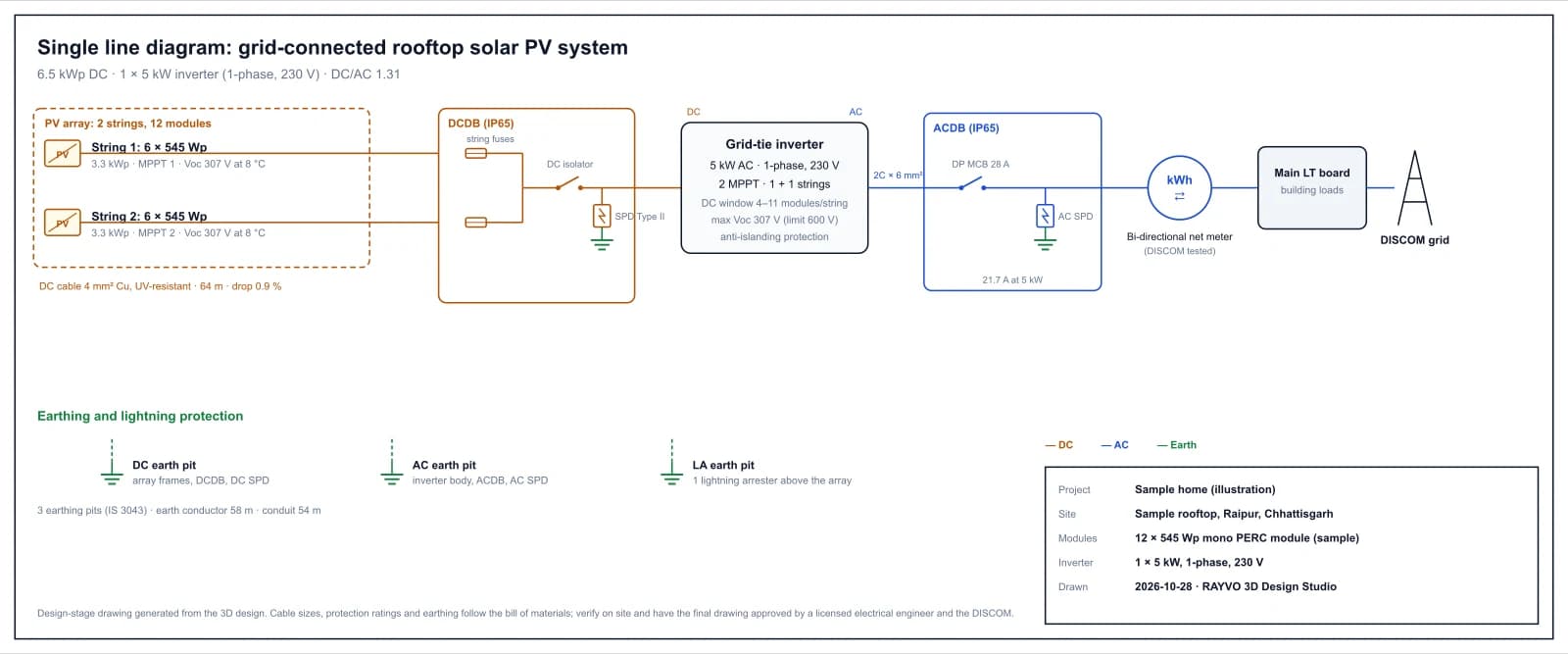
RAYVO designs the electrical side of a rooftop system from the layout: the inverter size, count and phase, how the modules are strung, the DC and AC cable sizes and lengths, and the protection in the DC and AC boxes, earthing and lightning arrester. The same figures go into the bill of materials, the proposal and the single line diagram.
What it does, how, and what you get
Each capability below says what it does, how it is worked out, what it produces and why it matters to installers and EPC companies.
Inverter size, count and phase
- What it does
- Chooses the inverter for the array.
- How it works
- One inverter while a standard size keeps the DC/AC ratio at or below 1.25, otherwise several units. Single-phase up to 6 kW, as Indian DISCOMs connect it, three-phase above.
- What you get
- Inverter count, AC kW, phase and DC/AC ratio.
- Why it matters
- The phase and size decide the connection application and the meter; a wrong choice delays net metering.
Temperature-adjusted string sizing
- What it does
- How many modules go in each string, and how many strings per MPPT.
- How it works
- Module open-circuit and maximum-power voltages are corrected to the site's coldest morning (for the inverter's maximum DC voltage) and hottest afternoon (for the MPPT floor and start voltage), using the site's weather record.
- What you get
- Minimum and maximum modules per string, the string plan per inverter and MPPT, and the highest string voltage against the inverter limit.
- Why it matters
- A string that is fine at 25 °C can exceed the inverter's voltage on a cold winter morning.
MPPT and current checks
- What it does
- Checks each inverter input.
- How it works
- Parallel strings on one MPPT are kept equal; short-circuit current per input (Isc × 1.25 × strings) is checked against the inverter's limit, and uneven strings sharing an input are flagged.
- What you get
- A pass or a plain note explaining what to change.
- Why it matters
- Mismatched strings on one input lose power quietly for 25 years.
DC cable sizing and lengths
- What it does
- Sizes and measures the DC cable.
- How it works
- Each string's home run is measured from the layout to the inverter location, with jumpers between tables; the size is 4 or 6 mm² to keep the drop at Imp within 1.5 % of the string voltage.
- What you get
- DC cable size, metres, voltage drop % and MC4 connector pairs.
- Why it matters
- Cable is bought by the metre; a measured length avoids both shortages on site and waste.
AC cable and ACDB
- What it does
- Sizes the AC side.
- How it works
- The AC current sets the cable size by ampacity with a 1.25 margin, increased until the drop stays within 2 %; the ACDB carries a DP or 4P MCB rated at 1.25 times the current and an AC SPD.
- What you get
- AC cable size and length, MCB rating, ACDB and net meter type.
- Why it matters
- Correctly rated protection is what the DISCOM inspector checks first.
DCDB, earthing and lightning
- What it does
- Protection on the DC side and for the structure.
- How it works
- DCDB with string fuses, DC isolator and Type II SPD; earthing pits to IS 3043 (three up to 10 kW, five above); lightning arresters, one per about 30 m of array.
- What you get
- Every protection item in the bill of materials with quantities.
- Why it matters
- Earthing and surge protection are safety items, not extras, and belong in the quotation from the start.
Design check before quoting
- What it does
- A pre-flight check of the design.
- How it works
- Validates setbacks, inter-row pitch, structural loading and string compliance, and grades each item as critical, warning, info or pass.
- What you get
- A list of what to fix before the quotation goes out.
- Why it matters
- Catching a string or spacing mistake on screen costs nothing; on the roof it costs a site visit.
What the outputs look like
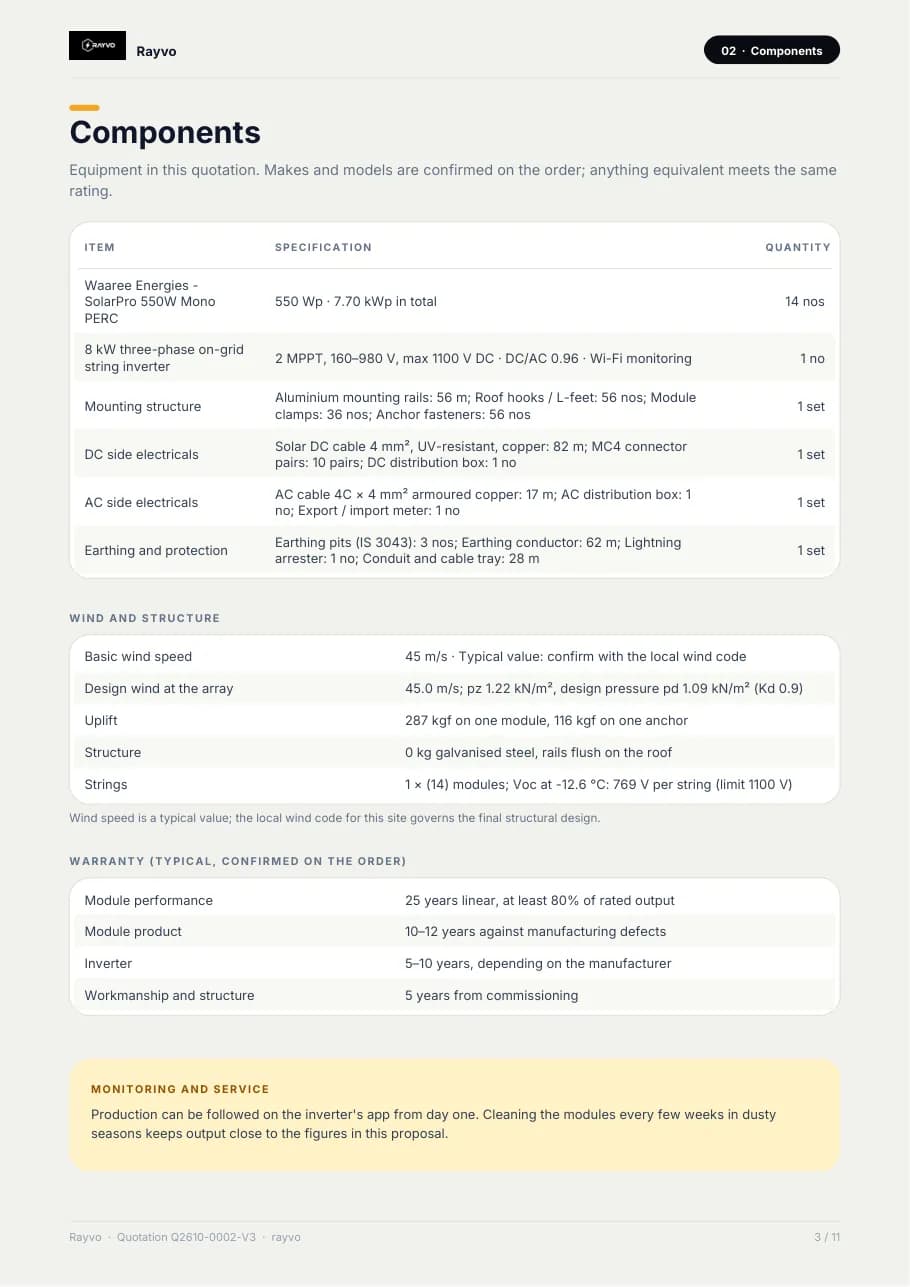
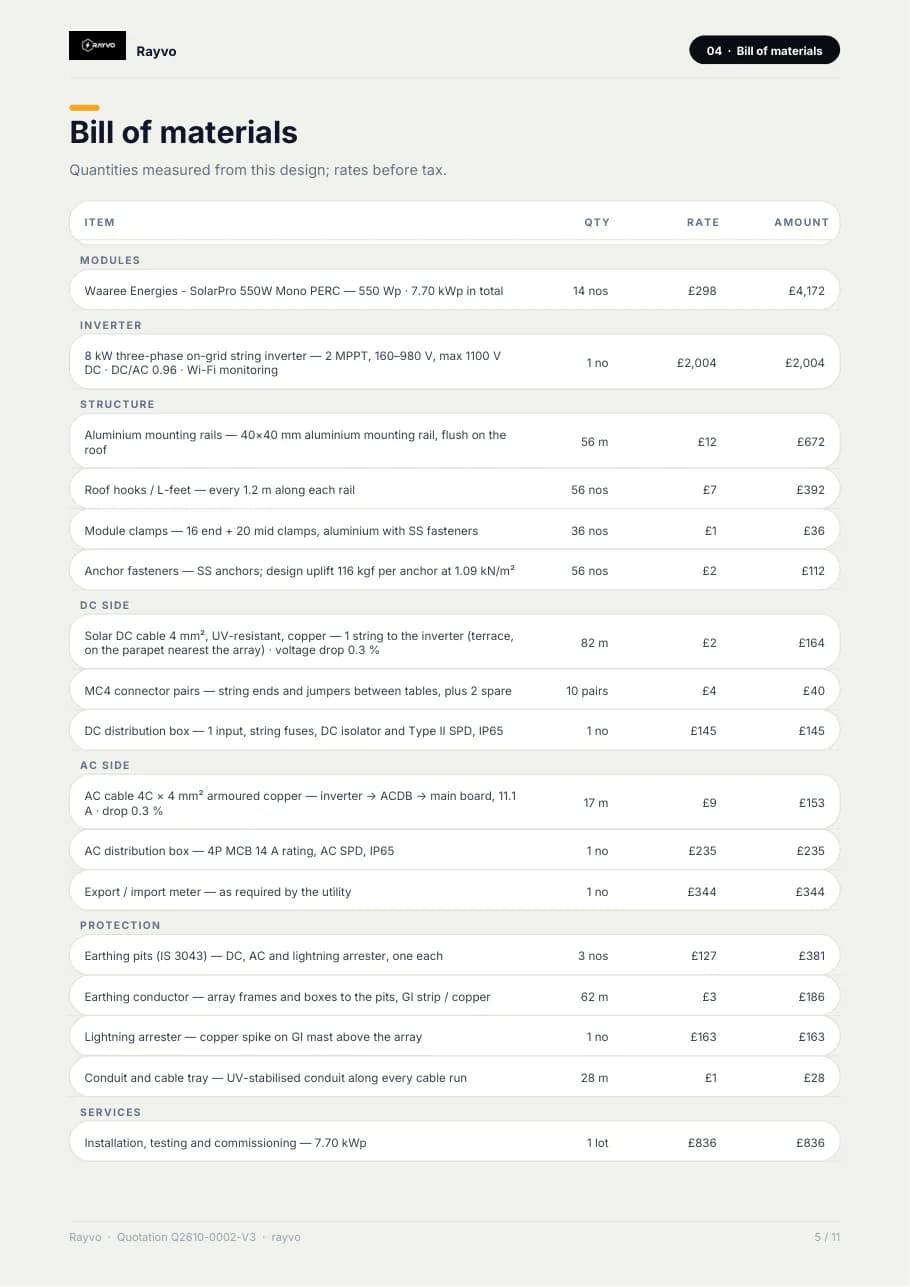
Screens from the RAYVO 3D Design Studio, pages from its proposals, and sample drawings marked as illustrations.
Four steps on one design
- 1
Choose the module
Datasheet values come from the module entry.
- 2
Read the site temperatures
Coldest morning and hottest afternoon at the address.
- 3
String and size
Inverter, strings per MPPT, DC and AC cables.
- 4
Protect and document
DCDB, ACDB, earthing, lightning arrester, SLD.
The methods behind the numbers
Design-stage figures from recognised methods. Final structural and electrical designs are signed by licensed engineers.
| String window | Max modules = inverter max DC voltage ÷ Voc at the site low; min = MPPT floor or start voltage ÷ Vmp at the site high |
|---|---|
| Cell temperature | Ambient plus 30 °C at full sun, rack-mounted |
| Inverter rule | One unit while DC/AC ≤ 1.25; single-phase up to 6 kW, three-phase above |
| DC cable | 4 or 6 mm² copper, voltage drop at Imp ≤ 1.5 % |
| AC cable | Ampacity ≥ 1.25 × current, voltage drop ≤ 2 % |
| Protection | String fuses, DC isolator, Type II SPD; MCB at 1.25 × current, AC SPD |
| Earthing | IS 3043 pits: 3 up to 10 kW, 5 above; lightning arrester per ~30 m of array |
Solar Electrical Design questions
From the weather record for the address when it is available, otherwise from typical values for the latitude, and the drawing says which was used.
Yes. The electrical values come from the datasheet entry for the chosen module, so the string window changes with it.
Yes. String home runs and jumpers between tables are measured from the layout to where the inverter is mounted, terrace or ground.
No. It gives the design-stage electrical plan and the material list. A licensed electrical engineer verifies the final design and signs the drawing for the DISCOM.
More solar engineering in RAYVO
Ready to run your business smarter?
Bring your solar design, CRM, quotations, projects, finance and business operations together with RAYVO.
Or talk to us on WhatsApp at +91 90399 94090